Government says
"Significant headroom for higher-priority investments."
Nicola Willis · Finance Minister
Government says
"Significant headroom for higher-priority investments."
Nicola Willis · Finance Minister

PSA replies
"This is an act of wilful destruction."
Duane Leo · PSA National Secretary
Severity legend
Findings on this page are colour-coded by impact on the agency or service.
Key numbers
Headline figures from the pre-Budget speech in Auckland.
Charts
Headcount over time, and how NZ stacks up against peer nations.
FTE roles · 2017 → 2029 target
Number of departments administering Budget lines
Operating budget
Operating budgets for "most" agencies will be cut three years running.
Across the board to "most" agency operating budgets.
Compounding on the prior cut.
A cumulative ~11.6% baseline reduction.
In plain English: "compounding" means each year's cut is applied to what's left after the previous year's cut. A 2% cut, then 5% on what remains, then another 5%, leaves about 88.4% of the original budget — so 11.6% is gone. The cuts don't simply add to 12%; they stack.
First confirmed merger
Three ministries folded into one mega-ministry.
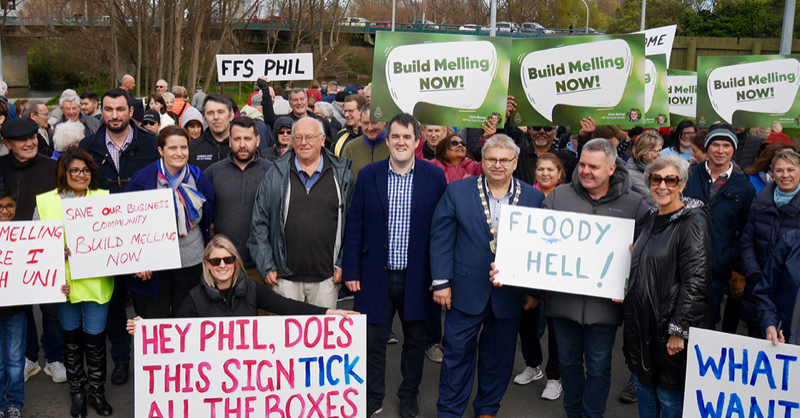
First visible test case for the restructure: one new ministry now, more merger proposals over the next 3-5 years.
Being merged in
Submissions on the bill
583 of 588 opposed — only 5 backed it.
Stated purpose
A "case study" for what's possible. Bishop expects MCERT to "cut back on spending and staff costs over the next few years". CE: Jeremy Lightfoot (ex-Corrections).
MCERT bill · public submissions
Of 588 submissions received on the bill folding the Ministry for the Environment into MCERT, just 5 supported it — under 1%. Each square is one submission.
In plain English: before Parliament votes on a bill, it asks the public — anyone from iwi and scientists to councils, businesses and individual citizens — to write in with their views. On this bill, almost everyone who wrote in (583 of 588) said no. The Government is proceeding with the merger anyway.
Source: Select Committee report on the Environment (Disestablishment of the Ministry for the Environment) Amendment Bill.
25 departments
Every department below must cut 2% this year, then 5% in each of the next two years. Bar shows year-on-year workforce change (green = already shrinking, red = grown the fastest).
Ring-fenced
Frontline and security agencies are ring-fenced from operating budget cuts, but can still face mergers or headcount changes.
The wider state sector — Te Whatu Ora (health), schools, Crown entities — is not counted in the cost-cutting programme at all.
AI & reinvestment
The Chief Digital Officer will oversee cloud migration and AI deployment across public entities.
Note: When pressed on how he personally uses AI, Public Service Minister Paul Goldsmith said: "well…ugh…ummm" before Willis intervened with "I bet your teenagers are." Willis admitted her own office "hadn't been using a huge amount of AI" but has now asked staff to "educate me about this".
Willis says the savings will be reallocated to:
Annual role reductions: NZ's only published AI benchmark vs the Budget 2026 pace
Named vendor · Public Service AI
The Public Service Commission's own rollout — under Commissioner Sir Brian Roche — names Microsoft Copilot, Copilot Chat and Copilot Agents. Procurement runs through the MCSSA, the all-of-government volume licensing deal administered by DIA.
Across the public sector, staff get Copilot because it's bundled with the existing M365 licence; other AI tools are blocked. The GCDO's Responsible AI Guidance (Feb 2025) doesn't require single-vendor lockdown — agencies default to it.
I'm not aware of a current local AI provider in the scale of Claude or Copilot, but what I would say is that we'll be making use of the best technology available.
The fiscal-multiplier argument
The headcount savings replace a domestic wage bill with payments to overseas software vendors. Each dollar moves through the NZ economy differently — visualised below.
The dollar trail · what happens to $1 of Crown spend
Schematic — each pill is a hop where some portion stays in NZ (tax, wages, or business income). Wage track keeps cycling; vendor track has one collection point (GST) before the principal exits to the offshore parent.
In plain English
When the Government pays a NZ public servant $100,000, a chunk comes straight back to the Crown as income tax, and most of the rest gets spent in NZ shops — paying GST again, paying other NZ workers' wages, paying NZ landlords. Economists call this the fiscal multiplier. When the Government pays the same $100,000 to a US cloud vendor, that dollar leaves NZ. No PAYE, no domestic re-spend, no multiplier.
The honest caveat — what does come back
Microsoft opened a hyperscale datacentre region in NZ (Dec 2024) and committed to upskilling 100,000 New Zealanders in AI and digital skills by end of 2026 (~75% achieved). Vendor profits still book offshore; operating spend on local hosting, NZ staff and training partly stays here. The wage-to-vendor swap reduces but doesn't eliminate the domestic recirculation effect.
Sources: NZ services-imports data (Stats NZ); Treasury / NZIER fiscal multiplier estimates for domestic wages vs imported services; vendor ownership per S&P 500 / corporate filings (Microsoft, Alphabet, Amazon, OpenAI); Microsoft NZ datacentre and upskilling commitments per Microsoft Source Asia / ITBrief NZ. The numerical gap between the two multipliers is contested; the direction of the effect is not.
Follow the money
Willis named four reinvestment priorities, but only one carries a confirmed dollar figure today. The full line-by-line allocation lands at Budget lock-up — 2pm Thursday 28 May 2026, a week from now. Below: what we know, what we're waiting on, and the parallel fiscal flow that opponents say cancels it out.
In plain English: the operating allowance is the pot of new money Treasury sets aside for the year. Pre-commitments are things already promised in previous budgets — wage settlements, demographic cost pressures, programmes mid-rollout. Of the $2.4B operating allowance for Budget 2026, most is already booked. Only about $1B per year is genuinely fresh money the Government can decide what to do with.
The four stated priorities
Year 3 of a multi-year cost-pressure deal — adds $5.48B to Vote Health across the forecast period.
Willis: resources will be "aligned with structured literacy and numeracy". Detail at Budget lock-up.
Capital allowance lifted to $5.7B (from $3.5B). Mix of new spend vs existing pipeline unclear pre-Budget.
Defence items withheld for commercial sensitivity — e.g. Boeing 757 replacement contingency.
Willis's own framing
“These savings will now be deployed to better purposes — to delivering more services in our health system, to increasing educational resources for our schools, to building infrastructure and strengthening our Defence Force and police.”
Critics say · the counter-flow

“Tax cuts for tobacco companies and property speculators — and make Kiwis pay for it.”
Labour and the PSA argue the cuts can't be read in isolation. The same coalition government has, over the previous two Budgets, restored full interest deductibility for residential landlords and removed the previous Government's tobacco-control measures — both tax-side decisions that sit in the same four-year forecast as the $2.4B in public service savings.
In plain English: "interest deductibility" means a landlord can subtract the interest they pay on a rental property's mortgage from their rental income before tax is calculated — so their tax bill is lower. Labour removed this for residential rentals in 2021 (it cost the Crown nothing — landlords just paid more tax). The coalition restored it in phased steps, fully effective 1 April 2026. The result: landlords pay less tax on rental income; the Crown forgoes the revenue.
Fully restored from 1 April 2026. NZCTU says the policy has already blown out ~$800M past National's pre-election forecast. Who specifically benefits is partly opaque — see the landlord data gap below.
From 8,700 role reductions, ministry mergers, the AI mandate and 2%+5%+5% compounding baseline cuts. Framed as creating "significant headroom" for the four reinvestment priorities above.
“This is a government that has spent billions of dollars on tax cuts for landlords and big tobacco while gutting the services working New Zealanders rely on.”
The landlord data gap
The most-cited figure — Labour's claim of "346 landlords with 200+ properties each", originating from a 2021 Stuff investigation and recirculated in NZCTU election-campaign analysis — was challenged in March 2024 when the Ministry of Housing & Urban Development's response to an OIA request found that only one landlord with 200+ properties could be substantiated in current data. Labour says it used the only publicly available figure at the time. The Government argues the disputed number shouldn't have been repeated.
Either way, no enumerated list of the largest residential landlords exists in New Zealand. Three structural reasons:
In plain English: the Government is foregoing roughly $3B over four years on a tax cut where the public can't see, with named precision, who's receiving it. Aggregate IRD modelling exists; an individual list does not, and would require law changes to publish.
What we DO know — ownership shape
Sources: NZ Herald (Thomas Coughlan, March 2024) on the 346 dispute and MHUD's OIA response; Stuff (2021) "Mega-landlords" investigation; NZ Herald / Ramifier analysis of LINZ + Companies Office data for ownership distribution; Kāinga Ora portfolio per official figures. NZX-listed REITs (Goodman, Precinct, Kiwi Property) are predominantly commercial/industrial and largely fall outside the residential deductibility regime.
Public service savings (announced) vs landlord interest deductibility (legislated) · same 2026/27–2029/30 forecast
By the math
Each line below is a calculation drawn from elsewhere on this page — pulled together so the arithmetic is in one place.
1 · The fiscal counter-flow
Landlord tax cut alone is ~$600M larger than the entire public-service savings figure. Same four-year forecast, same coalition.
2 · The AI productivity gap
Required pace of AI-led role reductions vs Immigration NZ's actual programme benchmark — the only published NZ data point on AI savings.
3 · The required pace
The public service must shrink by ~2,500 roles every year, sustained, for three and a half years — a pace outside the historical range.
4 · PSA's "1 in 4" claim
Cuts land on the ~36,000 FTE at non-exempt agencies, not the full 63,657 headcount. Willis disputes the framing as "hysterical".
Each calculation is sourced from material elsewhere on this page. Eq. 1 cross-references IRD modelling (NZ Herald) with Willis's 19 May figure · Eq. 2 from The Post's Immigration NZ programme report · Eq. 3 from Te Kawa Mataaho headcount baselines · Eq. 4 is the PSA's published estimate, disputed by Willis.
Voices
Coalition support, Opposition opposition, and a "DOGE" comparison from the Greens.
"Those savings… have created significant headroom for higher-priority investments — a total of $2.4 billion over the forecast period, averaging $597 million a year."
"Yes, there will be job losses over time. The public service is not a make-work function — it's not here just to maintain jobs and maintain a position of how it was always run since 1995."
"It's something the ACT Party's been calling for for a very long time, and we're absolutely thrilled to see it. ACT certainly would have done this faster and harder."
"55,000 must be the halfway mark, not the finish line. When National left office in 2017, the public service sat at around 47,000 FTEs — if that was enough then, it should be enough now."
"This is an act of wilful destruction. It will devastate the services New Zealanders rely on every single day. This is irresponsible and reckless — and make no mistake, the price will be high."
"There is no way you could reduce that many people working for our public service without reducing frontline services. These are social workers working with vulnerable kids and families, people working in our prisons, people working at our border, people working in the conservation estate."
"Last year, women paid for Nicola Willis's budget. This time, public servants and their families are going to be paying for it. There could be up to 10,000 families affected."
"The Government is chasing DOGE-style libertarian fantasies right out of Elon Musk's playbook. Nicola Willis is committing New Zealand to arbitrary headcounts which will eat into frontline services."
"40 years of a dedicated voice for the environment disestablished after 40 minutes of select committee."
"Precisely right. In the end, the principle should be, as in practically every other country, one minister with one ministerial portfolio, responsible for one government department."
Timeline
Deeper context
Five views that didn't fit above — the long historical arc, how fast the workforce really grew, where the money goes, which departments grew the most, and how NZ compares to peer nations on overall public-sector footprint.
Core public service FTE ÷ resident population · 1995 → 2029 target
Cumulative growth, indexed to 2017 = 100
Reinvestment priorities named by Willis · indicative split
Annual savings (~$597M) in context of Budget 2026 spending
Green = already shrinking · Amber = modest growth · Red = grew the fastest, biggest target
Historical average, recent actuals, and the pace required to hit 55,000 by July 2029
Public sector employment as % of total employment · Nordics → NZ → Anglo peers
Quick answers
Self-contained answers to the most-asked questions about the 19 May 2026 announcement.
8,700 full-time-equivalent roles will be cut from the core public service by July 2029, reducing headcount from 63,657 (December 2025) to 55,000.
$2.4 billion over four years — averaging $597 million per year. Savings are earmarked for health, schools, infrastructure, Defence, Police, and debt reduction.
MCERT is the Ministry of Cities, Environment, Regions and Transport — announced Dec 2025, operational 1 July 2026. It combines the Ministry for the Environment, Ministry of Housing & Urban Development, Ministry of Transport, and DIA's local government functions. Led by Jeremy Lightfoot (ex-Corrections CE). Willis cites it as the template for further mergers.
13 agencies are excluded from operating budget cuts: NZ Defence Force, NZ Police, Corrections, Oranga Tamariki, Ministry of Health, Ministry of Justice, Ministry of Education, GCSB, NZSIS, Education Review Office, Crown Law, Ministry of Defence, Serious Fraud Office. They can still be merged.
Greens spokesperson Francisco Hernandez compared the programme to Elon Musk's US Department of Government Efficiency, saying the Government is committing to "arbitrary headcounts which will eat into frontline services". The Government rejects the comparison.
Compounding operating budget cuts: −2% in Budget 2026, then −5% in each of the next two years — a cumulative ~11.6% baseline reduction. AI adoption is mandated; headcount must be reported quarterly.
New Zealand has 39 departments — more than triple Finland (12), more than double Australia (16), and well above the United Kingdom (24). ACT's policy is to reduce this to 30.
Open questions
The announcement was big on top-line numbers and short on operational detail. Three questions the Government hasn't answered yet.
Beyond MCERT, no specific mergers were named. Agencies have been asked to propose their own. Seymour says the final department count will be "close" to ACT's 30-ministry policy.
The PSA is demanding the Government tell New Zealanders before the election. No service-level detail in the announcement — only that 13 protected agencies are ring-fenced from operating cuts.
Willis says cuts will come from "natural attrition, stopping duplication, streamlining back-office functions". PSA says the maths doesn't work without structural disestablishments.
Disputed numbers
PSA and Willis can't agree on what the headline 8,700 figure means once you strip out the 13 ring-fenced agencies. The Government has not published a per-agency breakdown.
"Tell New Zealanders which services they're going to lose. Front up before the election, not after."
Per-agency breakdown not yet published by the Government.
PSA's per-agency estimates
All three sit at roughly 1 in 4 jobs — the pattern the union says proves the headline number.
Bar width = % of agency workforce affected (not absolute roles). Source: PSA estimates citing the 19 May announcement; Willis disputes the calculation publicly.
Where the workforce lives
The capital holds the single biggest concentration of public servants — but more than half the workforce lives elsewhere, so the cuts ripple nationwide.

"Like a single-industry timber town."